Convoy course-change and formation procedures
The Good ShepherdConvoy course-change and formation procedures were the practical rules for turning a slow merchant convoy while preserving its columns, spacing, and protection. They made a seemingly modest change of heading a large coordinated operation: ships had to respond in sequence, adjust speed across the formation, and avoid crossing into neighboring columns. In the novel, each turn carries a double consequence. It redirects the convoy, but it can also loosen the formation the escort is charged with guarding.
Why Slow Convoys Turned Differently
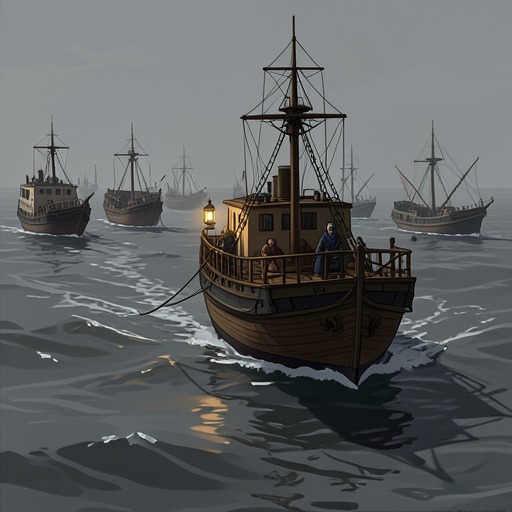
A slow convoy could not use the zigzag pattern of a fast convoy without prolonging its passage inordinately. Its course alterations came at long intervals, and maintaining the difficult lines of bearing used in the fast-convoy system was beyond what merchant captains could reliably manage. Holding a simple column and line was already demanding. The result was a slower, heavier method of maneuver: the convoy wheeled together through a change of only ten or fifteen degrees, but even that small alteration required coordinated action across a mass of ships.
The formation could not turn as if every vessel were moving on the same track. One wing had to maintain speed while the other reduced it, and the leaders had to put their helms over gently. Ships behind them had to follow at the right place and time. On a starboard wheel, a follower that turned too soon could end up on the starboard side of its leader, threatening ships in the next column; one that turned too late could head directly toward the ships to port. Either error left the ship needing to maneuver back into its proper position, a correction that was itself difficult in the crowded formation.
Speed, Signals, and Execution
The turn also imposed a speed problem across the convoy’s width. Ships on the outer flank had farther to travel during the wheel and therefore needed to move faster than those on the inner flank. Since the outer-flank ships were already steaming as hard as they could, ships in the starboard column had to reduce speed. The instructions issued to every captain gave standard proportional reductions for each column. Applying them still required someone to find the relevant figures in a large mimeographed booklet, make a quick calculation, and communicate a precise adjustment to an engine-room staff that might not be practised at carrying it out.
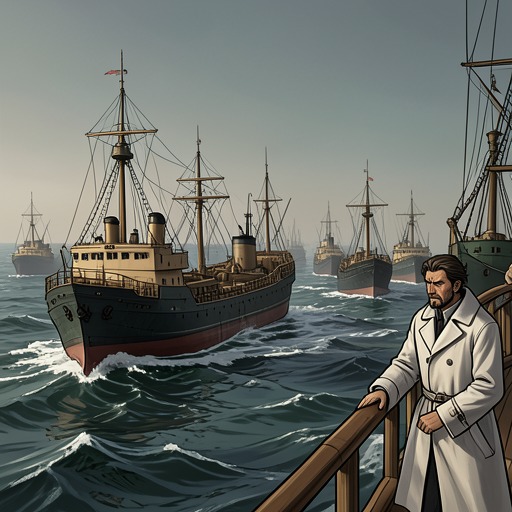
A convoy turn was governed by signals as well as by the written instructions. During one change, Carling reported that the Commodore was signalling; after the flags came down, Carling reported the executive moment, and then gave the order for Keeling to take the new course. Krause already knew the signal had been hauled down, but Carling still had to report it as part of his duty. The sequence distinguished notice of an impending maneuver from the moment when the formation was to begin it. The procedure depended on reports reaching the bridge and orders passing onward, even while the ships’ movement made observation and station-keeping difficult.
The Turn in Practice
The convoy’s actual handling could defeat the apparent precision of the instructions. Every ship responded to its rudder differently and had a different turning circle. Even if a captain found the correct speed reduction, the engine-room crew still had to make it accurately; following ships had to judge when the ship ahead began its turn. The rules provided a common method, not identical performance. Their success depended on numerous local judgments being made in the right order across the formation.
Krause watched one wheel from Keeling as the ship turned and tried to keep the convoy in his binoculars. The roll briefly swept the convoy out of view; when he found it again, confusion had appeared almost at once. The orderly pattern of lines and columns had become ships dotted haphazardly. This disorder was not an exceptional possibility separate from the procedure: it was a known consequence of putting the whole formation through a turn. The convoy’s response varied ship by ship, and its orderly geometry could not be assumed to survive the maneuver intact.
Consequences for the Escort
When columns opened out, the convoy occupied a larger area, increasing the front that the escort had to protect. Stragglers were another predictable danger. Experience had shown that a ship falling behind the formation would almost certainly be sent to the bottom. The course-change procedure therefore affected more than navigation: its execution could determine whether ships remained within mutual protection or became isolated and vulnerable.
The timing of a turn also shaped the escort’s choices. During one episode, Krause was told that the next zigzag was due in five minutes. The change would bring the convoy’s sterns toward Viktor and James, while James had already been detached and was moving farther from station. Calling her back immediately would still require about half an hour of high-speed steaming; waiting five more minutes would make the return take a full hour. The coming maneuver thus had to be considered alongside the position and recovery time of an escort ship, not merely as a change in the convoy’s heading.
The procedure’s central tension is between coordinated movement and the fragility of coordination. The prescribed signals, column rules, timing, and speed calculations sought to keep a large formation together, but the turn exposed differences in ships, crews, and responses that instructions could not erase. Each slow wheel was at once a routine alteration and a temporary disruption of the screen’s protective arrangement.